Tuesday, October 2, 2012

Vermeer's Love Letter to Society


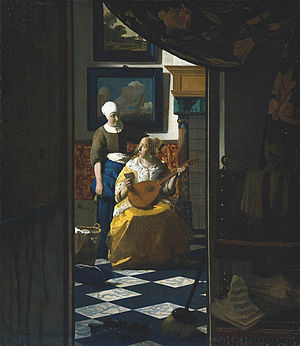
 While examining Johannes Vermeer’s painting, The Love Letter (c 1669) it became clear that the artist was striving for what Jay David Bolter and Richard Grusin’s work, Remediation, describes as “transparent immediacy” as we, the audience, are meant to forget that we are looking at a painting/canvas and are instead propelled into its storyline (21-2). Forced to view the work from the artist’s voyeuristic prospective—deep within the closet looking into the room, which is reinforced by the shelving at the forefront and immediate right of the scene—the audience is left with the impression that they are illicitly spying in on a very personal moment. Indeed, the canvas disappears and we are there, crouched within that closet, either with or as the artist, encroaching on this young maiden’s privacy as she plays her lute and inadvertently (or not) we witness, as the title of piece suggests, the obviously wealthy young woman’s request to her servant that she deliver a love letter. Additionally, the subject matter of this piece highlights the 17th century’s view of women as chattel. The fact that women are first the property of their fathers then their husbands, during this time period, and used as commodity to advance the family’s social, political and monetary aspirations within the public sphere, they are, by definition, not free to choose who to love or marry. History, then, reinforces the work’s “immediacy”—as it supports the storyline advanced by the painting: a young woman with no agency is forced into an act of subterfuge with the assistance of her servant—a popular storyline utilized previously by both Ovid and Shakespeare. Therefore, even as this paper would represent a remediation of Vermeer’s work, as the “literary description” itself is a remediation of “visual art,” it is the artist’s prospective and the point in history when it was created that adds credence to the piece as a subject representative of immediacy  (45). 
Additionally, The Love Letter, would seem to bring to light issues of the public and private spheres as described by Jurgen Habermas’s work, The Structural Transformation of the Public Sphere: An Inquiry into a Category of Bourgeois Society. Now, one would assume that as the scene depicts a private moment between a young woman and her servant, presumably within her own home (if not her own room) that the space itself would be defined as a private sphere. Yet, the painting could also be representative of Habermas’s assertion that the “intervention of public powers in the affairs of private people” was a byproduct of society’s inability to resolve their issues from within the private “salons” (35, 142). Essentially, the “public sphere” began as an amalgamation of private citizens, who gathered together in the hopes of affecting public change. Thus, if, as the painting’s title suggests, and the protagonist’s expression of concern as she covertly passes said letter to her servant reinforces, the “public” reaction to this young woman’s affections for the recipient of this letter is a point of contention that she is attempting to avoid, and the we, the public in the closet, are meant to be outraged by and perhaps even meant to intercede in—no doubt, for the greater good of society.
Although perhaps an innocuous subject matter when viewed from a modern day perspective, it is easy to imagine that when viewed from within the prospective of 17th century society the information conveyed by Vermeer’s piece may well have been considered scandalous if not subversive. While it is unclear how many people would have had access to the painting when it was originally created, it could be assumed that it would have, at the very least, been prominently displayed within someone’s home and accessible to all visitors. Nevertheless, the sheer quantity of information conveyed: locking away young women may not be enough, maidens are clever, devious, disobedient, impure in thought or action, one must be the ever vigilant, like the audience in the closet etc…, would seem to add credibility to the suggestion of many scholars that far from a byproduct of post-industrial/modern societies, the information society is more than likely a “continuation of pre-established relations” (Webster 7). Thus, even as there is no doubting that with the advent of technology, the “information society” of today is afforded many more avenues for accessing information, “quantity” does not necessarily equate to “quality” information—and as Vermeer’s work demonstrates, it is not necessarily a byproduct of modernity (21-31).  Thus, as Frank Webster suggests in his work, Theories on the Information Society, “we must not confuse the indispensability of a phenomenon [(technology)] with a capacity for it to define a social order” (23) as much of the information derived from the advent of technology can easily be described as “devoid of content” (31).


Works Cited
Bolter, Jay David and Richard Grusin. Remediation: Understanding New Media.
Cambridge: The MIT Press, 2000. Print.
Habermas, JÜrgen. The Structural Transformation of the Public Sphere: An Inquiry into
a Category of Bourgeois Society. Cambridge: The MIT Press, 1991. Print.
Vermeer, Johannes. The Love Letter. 1669. Rijksmuseum, Amsterdam.
Webster, Frank. Theories of the Information Society. New York: Routledge, 2006. Print.

Wednesday, September 26, 2012

Habermas's Utopian Pipedream

Although reading Frank Webster’s Theories of the Information Society helped me to better understand Jurgen Habermas’s The Structural Transformation of the Public Sphere, it did little to alter my opinion that Habermas’s concept of a “public sphere” not only never truly existed, but could, in fact, never exist because the politics of information are, and have always been, inextricably intertwined with that of power. Even today, it is those in power who not only determine what “information” is relevant, but with the media of the world in fewer and fewer hands, what is actually disseminated as news or information around the world. Thus, even as an American woman living in the 21st century, who it would seem is no longer disenfranchised from Habermas’s “public sphere,” and has a plethora of information readily available to me, the reality is that ready access to the ever increasing “quantity” of information available does not necessarily correlate to the availability of “quality” information (Webster 21-3). Moreover, Habermas's theory does not address the fact that there are many members of society who are still disenfranchised from accessing, much less participating in, his “public sphere.” And though admittedly here in the U.S. it would seem more likely to be an exclusion based on economic issues rather than that of class, gender, culture etc… that cannot be said of the world in general. Therefore, as it is highly unlikely that we will ever live in a world where equal access to information that is untainted by power is available to all, the public sphere as conceived by Habermas will remain a utopian pipedream.

Tuesday, September 18, 2012

No Public Sphere for You!

Admittedly, after taking Habermas’s historical odyssey about the formation of the “public sphere” I was left with questions about its connections to power (particularly, white, male power). If, as Habermas theorizes, the public sphere was begotten of the economical developments of capitalism and the “literary public sphere,” which is dependent on one’s level of education and ownership of property, then the public sphere excludes a large portion of the “public”: women, the poor, people of color, and those who were prevented from owning land--again, women, the poor and people of color… Thus, far from articulating the interests of a hypothetical “civil society,” by the author’s definition, the “public sphere” functions instead as a representation of patriarchal white society—essentially another tool by which to consolidate and/or manipulate power and reinforce artificial hierarchies. Thus, there is no true universal “public sphere.” As such, I found the connection to the supplemental reading, particularly Selfe and Selfe article interesting, as I had never truly considered how the “systematic domination and marginalization of certain groups” extended into the use “media literacy” (Selfe 482). In other words, like the illusion of a “public sphere” which represents all of society, but in fact excludes a great portion of it, “media literacy,” via the use of “English as the default language” (490) and its “associat[ion] with patriarchal culture and rationalistic traditions of making meaning,” (491) also excludes a majority of the world’s population, thereby reinforcing artificial hierarchies and consolidating power.

Tuesday, September 11, 2012

Hypermediacy + Remediation = Immediacy?

While reading how Disneyland and Disney World function as hypermediate spaces that remediate their own creations, (“films, songs characters” etc…”) I remembered reading about an actual community called Celebration Florida in Osceola, Florida, built by the Disney Development Company and refashioned as an extension of Disney World’s Main Street attraction, which itself mirrors the idyllic Midwestern town in Marceline, Kansas where Walt Disney lived as a child (173). A complete community with its own schools, shops and places of worship, it is connected to the Disney World resorts via one of the community’s main streets. If it is true then, as the authors suggest, that “real cities and towns are themselves media spaces which theme parks reproduce and refashion,” it would seem that Disney World’s “small scale version of a city” (174) has re-evolved into an actual community—does this mean that the hypermediate fantasy has been remediated into the reality (immediacy)? Has it come full circle? In other words, if it is now possible to live within the "refashioned/remediated" fantasy, does that then become the reality ("immediacy")(174)?

Friday, September 7, 2012

Remediation at Work

Written by Maria Martin-Aran & Laurisa White Reyes VIDEO GAMES:  The text REMEDIATION by Jay David Bolter and Richard Grusin refers to early 1st person video games such as Myst, which was ground breaking for its time in that it had realistic graphics and enabled the player to feel as though they were actually moving through the game itself. Of course, all preceding video games attempted immediacy - bringing the player right into the game -but Myst succeeded where the others had all fallen short - to create the illusion of being in the game. Myst was twenty years ago and since then computer graphics have continued to improve to the point that digital graphics, when desired, are almost indistinguishable from live action.  A modern example is the game Bioshock. In this game, the player is the protagonist within the story. (As opposed to third person games where the player simply manipulates a visual representation of the protagonist.) The camera angles are all from the player's point of view, including seeing his own hands and the weapons he is holding.  The game strives for immediacy, however the fantastical nature of the story and the creepy, surreal nature of the images reminds the player that this is indeed a video game, thus keeping it hypermediate.
A better example might be the contemporary war video games such as Modern Warfare where gaming mimics actual battles during World War II and others.  The graphics at times are so real that it the characters might pass for actors in a movie rather than animated figures. These games are perhaps some of the closest examples we have of mediacy in today's world of entertainment.
TWITTER Twitter represents itself to be a "real-time" information network by connecting its members in real time. And in that sense it is in some way attempting mediacy. Yet while true that people are tweeting information "live" as it happens or occurs to them, the limitation of 140 characters, photos or short videos, as well as the vehicle for the information itself (ie. cell phones) makes it impossible to ignore its hypermediate aspects. As such we would argue that Twitter is basically, as the book describes, "narcissistic" in nature purposely bringing attention to its formatting in an attempt to entice usage and win converts. In that manner, it employs celebrities to create accounts and compete for followers to enhance its popularity and desirability. MOVIES (YouTube) YouTube is an excellent example of remediation. It is a digital online vehicle that connects viewers to video clips including movies, tv shows, music, commercials, and more. Anything that has been filmed can be posted to YouTube. It is remediating television, the movie screen, the home video, etc. But even though it is a very visible form of media itself, it strives to be immediate - to bring these video clips directly to the viewer with minimal effort or waiting.
One way it succeeds in achieving mediacy is the option to full screen. In this instance the video fills the complete computer screen and at the same time the You Tube logo and website disappear. It allows the viewer to temporarily forget about You Tube altogether - although he is still very much aware of the film and the computer themselves as forms of media.